The High-Functioning Burnout: When Excellence Becomes Erosion


By the time most leaders recognize burnout in themselves, they have already spent months mistaking it for ambition. They are still hitting their targets, their client reviews still read like recommendation letters, and their calendars remain as packed as the year they were promoted. What has shifted is harder to measure on a dashboard: the recovery time after a hard week, the patience with a difficult colleague, the appetite for work that used to feel like a vocation.
That widening gap between visible performance and internal cost was the throughline of last week's C-Suite Coach Chat with Meghana Karanjkar, an ICF-credentialed executive coach with more than twenty years inside Accenture, Deloitte, KPMG, and Cognizant. In conversation with C-Suite Coach founder and CEO Angelina Darrisaw, Karanjkar offered a sober diagnosis of the modern enterprise: burnout no longer announces itself with collapse. It hides behind performance.
The new shape of burnout
Engagement levels among U.S. employees have been falling for years, a trend Karanjkar argues is a leading indicator for the burnout cycle that follows. "If you're not engaged, your level of stress is going to be that much higher," she said. "And that eventually leads to burnout."
The leaders most at risk are the ones least likely to flag it. They are still producing. They are still being promoted. But sleep no longer restores them. The mind no longer powers down at the doorstep. Migraines arrive. Blood pressure climbs. Family relationships fray. The internal cost goes unspoken because the external scoreboard still reads "win."
"You are expected to deliver results at the same level you've always delivered, and even higher," Karanjkar said of the consulting culture she came up in. "There's no room to admit you're going through burnout."
Why values come first
Coaching, as Karanjkar practices it, does not begin with productivity hacks or boundary scripts. It begins with values: the non-negotiables a leader can no longer name out loud after years of accommodating someone else's priorities.
She described a recent client, a healthcare executive, whose mandate increasingly required her to greenlight policies that compromised patient outcomes. "Her values were so deeply rooted in ethics," Karanjkar said. "There was a constant battle between her own ethics and the values of the organization."
That gap is where burnout grows. When the work erodes the things a leader most needs to protect (health, relationships, integrity, agency), performance becomes a costume. The energy of high performance comes from purpose. Burnout is what's left when purpose leaves and the obligations remain.
The case against the dramatic overhaul
Leaders who finally seek coaching for burnout often arrive expecting an overhaul, a sabbatical, maybe career change, or a radical reinvention. But Karanjkar's prescription is the opposite.
"The client may not come up with all these steps. They may just want one small step," she said. "But once they take that one step and see how it changes their day, they get brave enough to try something else."
The most common first move is a single boundary on inbound work: no emails after 7 p.m., no Slack on PTO, no meeting requests before the morning's first coffee. The boundaries themselves are unremarkable. Their effect, compounded over weeks, is not.
What managers can do without a budget
For the leaders responsible for teams, Karanjkar's framework requires no HR sign-off and no new line item. It requires listening for what is not being said.
Weekly check-ins that stay transactional (deadlines, deliverables, next week's priorities) close the door on the conversation that actually matters. The high performer who has stopped raising her hand for stretch assignments. The team member who has grown cynical or short-fused. The cues are rarely verbal. They are almost never volunteered.
"If managers can really know that this is happening in the work culture today, and look for the signs," she said, "it would be of tremendous help to everybody."
The invisible tax on women and BIPOC leaders
The conversation turned candidly to the compounding pressures on women and BIPOC leaders, pressures rarely surfaced in performance reviews or engagement surveys.
Karanjkar described a recent client whose manager had not learned her name in two years. She described the "diversity tax" of being asked to lead DEI workshops and webinars on top of full workloads, the additional labor often invisible to compensation committees. She described the cumulative weight of microaggressions that no one names, and therefore no one can address.
The strategies, she said, are individualized by necessity. Awareness of bodily reactions. A pause before response. Five minutes of fresh air mid-meeting. These are not solutions to bias. They are tools for surviving an environment where the bias has not yet been solved.
The identity question
Perhaps the most consequential thread of the conversation was the question of identity.
In an era of constant restructuring, leaders who have merged self with title carry a fragile asset. "Jobs are disposable at the end of the day," Karanjkar said. "You need something to balance those stresses, something that nourishes your soul. What fills your cup other than work?"
Her answer, for herself, has been yoga and fiction writing. For her clients, it is whatever they have not had time for: a book they have not opened, a walk they have not taken, ten minutes of weight training before the meetings begin. The principle holds regardless of the practice. A sustainable career is built by people who exist beyond it.
The takeaway for L&D leaders
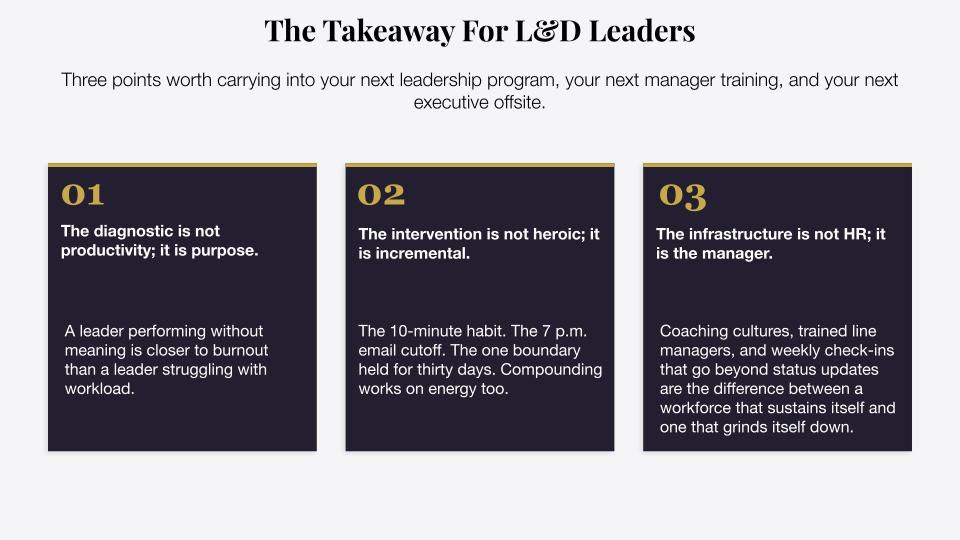
Three points worth carrying into your next leadership program, your next manager training, and your next executive offsite.
The diagnostic is not productivity; it is purpose. A leader performing without meaning is closer to burnout than a leader struggling with workload.
The intervention is not heroic; it is incremental. A ten-minute daily habit, a 7 p.m. email cutoff, or one boundary held for thirty consecutive days will outperform any dramatic reset, because energy compounds the same way capital does.
The infrastructure is not HR; it is the manager. Coaching cultures, trained line managers, and weekly check-ins that go beyond status updates are the difference between a workforce that sustains itself and one that grinds itself down.
Burnout, Karanjkar reminded us, rarely arrives with a knock at the door. It arrives quietly, in the form of a leader who is still delivering but no longer recovering.

Want coaching for your team? Meghana Karanjkar coaches senior leaders, emerging managers, women, and BIPOC executives across industries. To explore working with her, or any of our coaches, reply to this email or visit C-Suite Coach to start a conversation.
C-Suite Coach helps organizations develop exceptional leaders through targeted coaching and learning programs. To explore how we can support your team, schedule a consultation today.


Comments