The Rise of the AI Translator

The Silent Standoff
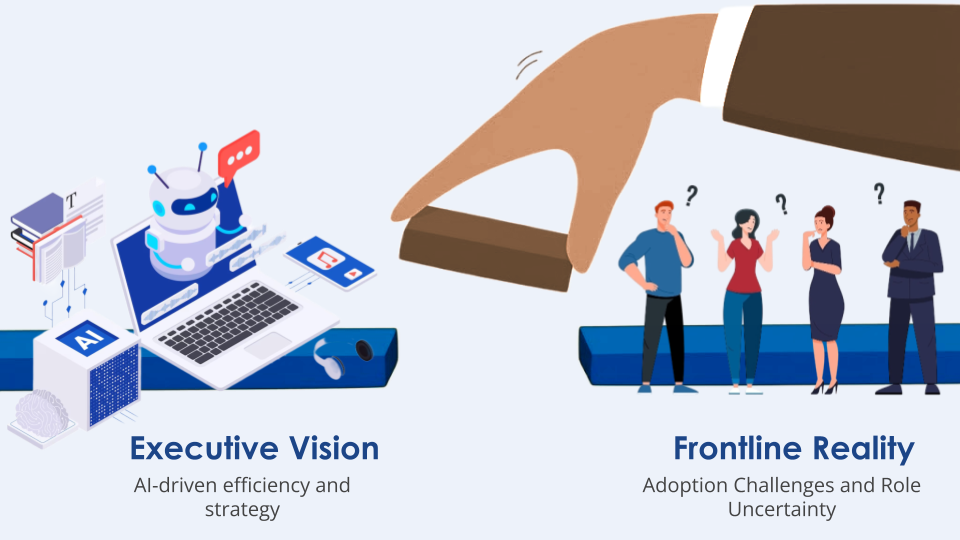
In boardrooms across the country, the directive is clear and urgent: We must integrate AI to drive efficiency. Licenses are purchased, tools are deployed, and leadership waits for the productivity numbers to spike. Yet three months later, the reality on the ground often tells a different story. Adoption is spotty. Some employees are quietly using these tools to speed up their work while hiding it from their supervisors, fearing that visible efficiency might lead to higher quotas or redundancy. Others are avoiding the technology entirely, paralyzed by the suspicion that training the model is equivalent to training their replacement.
Caught in the middle of this silent standoff are mid-level managers. We have spent the last year obsessing over the technology itself (the prompt engineering, the LLM capabilities, the data security), while largely ignoring the human infrastructure required to make it work. We are asking managers to bridge a massive divide between executive ambition and frontline anxiety without giving them the map to do so. This is what we call the AI Translation Gap.
The Cost of Missing the Middle The data confirms that this gap is widening. According to the 2024 Microsoft Work Trend Index, 75% of global knowledge workers are already using AI at work, yet 78% of them are bringing their own tools to the office because they lack guidance or sanctioned resources. More concerning is that 53% of people using AI worry that it makes them look replaceable.
This creates a dangerous duality inside teams. On one side, you have "Shadow AI" where unvetted tools are being used without oversight. On the other, you have a disengaged workforce freezing up out of fear. A recent Gallup report highlights that when managers actively support AI use, employees are nine times more likely to see the technology as helpful rather than threatening. The manager is the single most critical variable in successful adoption.
The Rise of the “AI Translator” We need to stop viewing managers merely as task overseers and start equipping them to be AI Translators. The new manager competency model requires leaders who can decipher which tasks belong to the algorithm and which require the nuance of human judgment. An AI Translator does not need to be a technical expert, but they must be an expert in psychological safety, ethical auditing, and workflow design.
1. Creating Psychological Safety Around Experimentation Employees will naturally hesitate to use a tool they believe might eliminate their job. The AI Translator changes this narrative by framing AI as an augmenter rather than a replacement. They create "safe sandboxes" where teams can experiment with new workflows without the pressure of immediate perfection. By explicitly stating that the goal is to reduce drudgery to make room for higher-value creative work, managers can lower the temperature and encourage curiosity.
2. Auditing the Process, Not Just the Result In a traditional workflow, the effort required to produce work acted as a quality filter. With AI, a polished result can be generated instantly, regardless of accuracy. Managers must shift from reviewing final outputs to auditing the logic and ethics of the process. This means asking questions about data bias, hallucination risks, and source integrity. The manager becomes an Editor-in-Chief who ensures that the "human in the loop" remains the ultimate authority on quality.
3. Discernment and the "No-Fly Zones" Perhaps the most sophisticated skill of the AI Translator is knowing when to forbid the use of technology. There are specific relational and high-stakes moments, such as delivering difficult feedback on a delicate matter, managing a client crisis, or navigating complex strategic alignment, where the presence of AI erodes trust. A skilled manager defines these boundaries clearly, ensuring that while the team leverages speed for administrative tasks, they double down on empathy for relational ones.

Moving Forward with Intention
We are currently in a fragile transition period where new tools are outpacing our habits. But the speed of change means L&D professionals have a rare opportunity: We get to shape the social norms, confidence, and capability standards of the next decade. This opportunity requires a shift in what organizations measure. Executives must move from assessing short-term efficiency to evaluating long-term efficacy. Managers need structured support and the budget to slow down long enough to learn how to lead through this disruption.
At C-Suite Coach, we are already seeing forward-thinking organizations pivot their L&D focus toward these human-centric skills. We are partnering with clients to build "AI Readiness" programs that focus less on the software and more on the leadership behaviors required to wield it responsibly. The organizations that win in this next phase will be the ones that recognize that while algorithms can generate content, only capable managers can generate the trust required to use it.
If your managers are feeling squeezed between the pressure to innovate and the need to maintain team cohesion, we can help bridge the gap. Our coaching and training programs are designed to equip leaders with the specific frameworks they need to navigate technological disruption without losing their human connection. Let’s explore how we can support your management team in becoming the translators your organization needs.
C-Suite Coach is the preferred strategic partner in talent development and business solutions. We are dedicated to helping your organization build a trusted workplace while cultivating a thriving culture. Submit a consultation request here to learn more about our services.


Comments